"I explore to celebrate adventures either planned or spontaneous journeys to know more about myself while exploring the world. "
Showing posts with label Tourist Attractions in Manila. Show all posts
Saturday, November 22, 2014
Tuesday, October 28, 2014
Hibla ng Lahing Filipino (The Artistry of Philippine Textiles), Museum of the Filipino People: Manila
| The Artistry of Philippine Textiles |
| Blouse |
Blouse
Central Panay / Sulod Bisaya
Commercial cotton cloth and threads
This embroidered cotton blouse with floral, butterfly and geometric designs comes from the Sulod group inhabiting the mountains along the banks of Panay River between Mt. Sya and Mt. Baloy. Anthropologist, F. Landa Jocano, studied with them and recorded his work in the book Sulod Society: A study in the Kinship System and Social Organization of a Mountain People in Central Panay (1968). During his research, he also photographed and collected Sulod material culture, including this blouse.
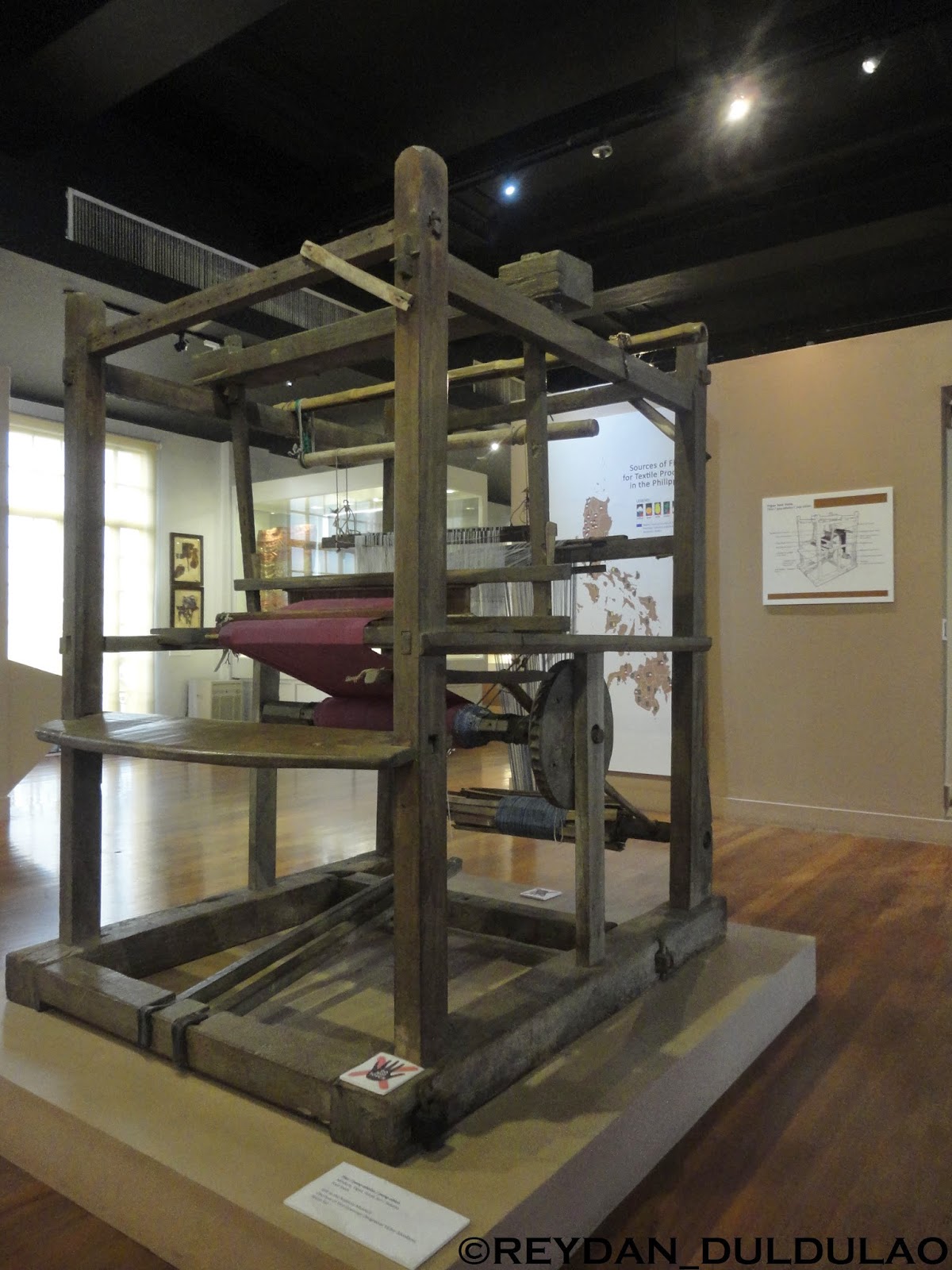
| Vigan foot loom |
| Abaca and Cotton |
Abaca fibers are traditonally extracted from a cut trunk by separating the surface leaf sheaths using a sharp object or knife, and pulling them off the trunk by hand. The fibers are knotted to form a continuous thread that would be suitable for weaving. Lanot is the general term for abaca used by the Bisayan groups as well as Mindanao groups such as the Mandaya. The Manobo sometimes also use the term yanot.
Cotton:
For the weaving, called hablon, the Hanunoo of Southern Mindoro cultivated cotton (Gossypium spp.), which they call burak. Seeds of the dried cotton are separated from the fibers, which are spun into threads by means of a manual spindle called burungan. Spun threads are dyed using the tayum plant (Indigofera tinctoray L.).
| Natural Dyes in the Philippines |
| Sources of Fibers for Textile Production in the Philippines |
| Traditional Weaving Centers |
Baybayin (Ancient and Traditional Scripts of the Philippines), Museum of the Filipino People: Manila
| Ancient and Traditional Scripts of the Philippines |
Prehistoric and pre-Hispanic evidences of Philippine script have been recovered from the archaeological record and from accidental finds. The National Museum has six in its collection, found in Laguna, Butuan, Batangas, Masbate and Manila.
The Laguna Copper-Plate, Calatagan Pot and Butuan Paleograph were declared as National Cultural Treasures (NCT) in 2010 by the National Museum.
To foretell the destiny of a nation, it is necessary to open the book that tells of her past.
| Laguna Copper Plate |
The Laguna Copper Plate was discovered by a quarry company in the Lumbang River, Laguna in 1989 in an ancient grave site, where gold ornaments, stone tools, bronze images, coins, stone adzes, porcelains, potteries, jade and other artifacts were also found.
Ten lines of characters cover one side of the plate, probably impressed or hammered, representing a script already rarely used by 900 A.D. (Postma 1991). Separate studies made by Antoon Postma, a Dutch researcher of the Mangyan ambahan for over 50 years and Dr. Johannes Gijsbuertus de Caparis, a Dutch paleographer, identify the main language as old Malay mixed with Sanskrit, old Javanese and old Tagalog terms.
Postma, translates the artifact's writing as Old Javanese script (Sanskrit Kawi) with Old Malay words (1991). It is about a case of partial debt payments in gold by a person of nobility, Namwran, to a Chief of Dewata representing the Chief of Mdang. The inscription was made as a document and witnessed by the leaders of Puliran (now Pulilan), Kasumuran, the leader of Pailah, Ganasakti and the leader of Bingwangan, Bisruta.
| Intramuros Pot Shard |
The Intramuros Pot Shard is the only artifact with ancient inscription recovered systematically. This pottery shard was retrieved below the brick floor of the Iglesia de San Ignacio in Intramuros, Manila in 2009. Found associated with trade ware ceramics attributed to Ming Dynasty (15th-16th centuries A.D.), this artifact has an ancient inscription on its shoulder.
| Monreal Stones |
The tablet (big stone) and stone (small stone) were found inside the compound of the Rizal Elementary School in Monreal, Ticao Island, Masbate and was brought to the National Museum in October 2011. The bigger stone (Monreal Stone 1) have both sides engraved with scripts. One side (Side A) has seven lines with 56 characters, while the other side (Side B) has 10 lines with 84 characters. The small stone (Monreal Stone 2) has 16 characters.
The Monreal Stones are the first discovered stone artifacts with ancient inscription or baybayin. An article made my Dr. Ramon Guillermo (2013) is about transcription of the inscription that was collectively formed by an interdisciplinary group of "UP Ticao, Masbate Anthropological Project Team". This article is about the systematic study of the inscription on the Ticao Stones and suggestions that will lead to its possible translation. Also, included in the article are the problems regarding the issues on the authenticity of the stones.
Philippine Biodiversity and the National Museum, Museum of the Filipino People: Manila
The biological diversity of the Philippines is extraordinary rich and includes the highest concentration of endemic species known in the world. Biodiversity scientists now consider the Philippines as a superpower of global biodiversity. Some of the process crucial to the evolution of the unique biodiversity of the Philippines are: i) the islands' complex geological history with long periods of isolation, ii) a dynamic sequence of fragmentation and coalescence of landmasses during the Pleistocene brought about by sea-level changes, iii) authochthonous diversification and speciation of ancestral species stocks within the archipelago, and iv) a biota that was derived from two distinct biogeographic regions of the planet.
Information amassed from biodiversity inventories in recent decades has tremendously enriched biodiversity knowledge in the Philippines, enhanced ongoing conversation efforts, and also provided the foci for identifying key biodiversity areas across the islands. Among the most astonishing results of field surveys undertaken by scientists was the persistent discovery of undescribed species, not only of poorly known or uncharismatic groups (such as earthworms, rats, bats, snakes, and lizards) but even of well studied groups (like birds, butterflies, and flowering plants) and relatively large and conspicuous species (such as parasitic plants of the genus Rafflesia, marine crustaceans, and flying foxes).
"The greatest service which can be rendered any country is to add a useful plane to its culture." Thomas Jefferson
| Philippine Eagle |
The Philippine Eagle: A symbol of pride and dignity of Filipinos.
The Philippine Eagle, Pithecophaga jefferyi is one of the world's rarest, tallest, powerful bird of prey and also one of the most threatened animal on earth. The first specimen was discovered in Paranas (Bonga), Samar by British explorer/naturalist JohnWhitehead in 1896. The Philippine Eagle was formerly known as the Monkey-eating Eagle because when it was discovered, it was observed to prey exclusively on monkeys. The description of its genus was derived from the Greek word, "pithecus" meaning "ape or monkey" and "phagus" meaning "eater of". Likewise, the species was named after John's father, Jeffery Whitehead, who funded most of his expeditions.
The Philippine Eagle, after a recent comparison with other large eagles of the world probes to be the largest in size. It was declared the Nationa Bird of the Philippines in 1995 bu former President Fidel V. Ramos under proclamation 615 through the efforts of foreign environmental advocates and Filipino biologist. Prior to the Philippine Eagle, our former national bird was the "maya" which refers to a group of birds called munias.
| Spot-billed Pelican Pelicanus philippinensis |
The only species of Pelican recorded in the Philippines. It breeds in the country despite the occurence of migratory populations. It is once considered common in Laguna de Bay and Candaba marsh as well as in the coast in Bulacan in the early 1900s. They are believed to be extinct in the Philippines with no documented records since 1940.
Spot-billed Pelican is found in southern Euro-Asia east to China, south through Southeast Asia to Sumatra and the Philippines.
In the Philippines, the species is known to occur in Luzon: Bulacan, Tarlac, Pampanga, Laguna de Bay, Bicol, Pangasinan, Cagayan Valler in Isabela and in Mindanao; Lake Bulusan, Liguasan Marsh, Rio Grande and Gulf of Davao.
| Sarus Crane Grus Antigone luzonica |
The Sarus crane Grus antigone is the tallest flying bird in the world. Sarus cranes are found in two continents and are the only species of crane that breeds in India and Southeast Asia. It is once reported as abundant of the plains and marshes in Central Luzon at Candaba marsh and in the Cagayan River Valley in northern Luzon. Surveys made by the Bureau of Forest Developments in the '70s and '80s produced no records.
Sarus cranes are found in Northern India, Southwestern China, Southeast Asia, northern Australia and the Philippines. The specimen of Sarus crane represents the extinct Philippine subspecies Grus Antigone luzonica. Recent sightings of the species were in 1979 at Tabuk, Kalinga Apayao and in the 1960s in the municipalities of Jones Ilagan and Cauayan, all in Cagayan River Valley.
Tuesday, September 30, 2014
Rizal Park: Manila
Sunday afternoon and my feet were itching to go somewhere else. I couldn't think anywhere to go, then suddenly I asked myself, "Why not visit Rizal Park?". After a few minutes of contemplating I then decided to get dressed and hit the road. After all, I have strolled around this place but I never had a chance to take a picture with our national hero, Dr. Jose P. Rizal.
I left home around 16:00. Weather is not not too hot and it's gloomy outside, feels like rain will pour down anytime soon so I brought with me my umbrella. I arrived at the park after an hour ride. I was so delighted to see many local and foreign tourists in the park. I took some few moments to think how great our national hero. I remembered him a lot through his book "Noli Me Tangere" and "El Filibusterismo" way back college days.
| "tallest flagpole and largest Philippines flag I have ever seen" |
Rizal Park is also known as the Luneta Park. It is adjacent to the old walled city of Intramuros. It is a very important historical site in the Philippine history. It is where our national hero executed on December 30, 1986, which fanned the flames of the 1896 Philippine Revolution against the Kingdom of Spain.
I started to stroll around the park to check what other things can it offer to the public aside from the rich Philippine history and I noted some. Taking picture/s with our national hero, that's the foremost reason why I went here, so simple but memorable for me. How about you? Do you have a picture taken with our national hero? If yes then show me. You can also take pictures with our first hero "Lapu-Lapu" on the other side part of the park.
You can also visit the Relief Map of the Philippines! Yes, you read it right, there is a relief map of our country situated in Rizal Park. How cool is that?! You can even walk on top of our country using a footbridge, I enjoyed that moment wherein you can also see the topography of our country.
You can also see head sculptures around the park (I think they are also Philippine Heroes). Take pictures with them as long as you want. I was not able to look at them on by one. That is definitely time consuming! Haha!
| "dove houses" |
Security on strolling the park is not a problem. Policemen is visible around the area. They have a quarter in the park. Just be cautious on your belongings and you will be safe. There are also tourism officers on the area which can assist you if you have problems.
| the police quarters |
You can enjoy watching the fountain while having picnic with your family. It is a great place for family bonding. Well, I also noticed that most teenagers spend quality time with their friends here. Some were even doing projects and some were practicing dance moves. Lovers who are in a romantic dates are also visible on the park. (Haha, di ako nainggit, seryoso!)
You can also try riding on a "calesa". Still a good thing that these rides are still existing in the place. I couldn't remember my last ride on this. Well maybe next time I will try once again. You can also play on the ground. I was not able to noticed if there were picnic goers who played kite. I doubt, it was not a windy day.
Rizal Park has gardens, orchidarium, a grand stadium, an observatory, an open-air concert hall, an artist's sanctuary, a light-and-sound theater, restaurants, food kiosks, playgrounds to satisfy your needs and wants.
When I am almost done with my tour, the rain started pouring. Good thing I brought my umbrella. The rain did not stop me from strolling the place (haha wais to!). Took pictures all over the place.
The park has also historical markers and plazas and a dozen of fountains. The park also features a fountain show for the delight of the tourists.
After more than an hour, the rain stopped and with that I had the chance to capture a special moment with our national hero (finally, nakapagpa-picture ako kay idol Jose, hehe). Lucky enough, there were only few tourist on the place so I grabbed the opportunity to ask one of the tourists to take a picture of me (lakasan lang ng loob yan).
| "first ever picture with Dr. Jose P. Rizal" |
It was a great city tour. Enough to kill my boredom at home. It's always great to visit some historical landmark once in a while rather than just staying at home doing nothing. I even witnessed how beautiful the park at night! I also have a glimpsed on the fountain show which was witnessed by many tourists who waited for the event.
Having this king of memorable trip, I planned to visit Rizal's House in Calamba City, Laguna anytime soon. Want to travel with me?! Let me know!
| "the fountain show" |
Commentary: With the hot issue happening in Rizal Park and after visiting the place, I've got simple questions on my mind. Who approved the permit issued to the contractor of the building? Does the Manila Government received any amount of money from the builders for them to issue the permit? Do the city government, knew the rules being implemented on the park? If yes, why does the government allowed the construction? Ignorance of the law excuses no one. And lastly, how long it will take for the government to issue a formal decision about this?
Got comments?! Feel free to write down below.
Subscribe to:
Posts (Atom)